

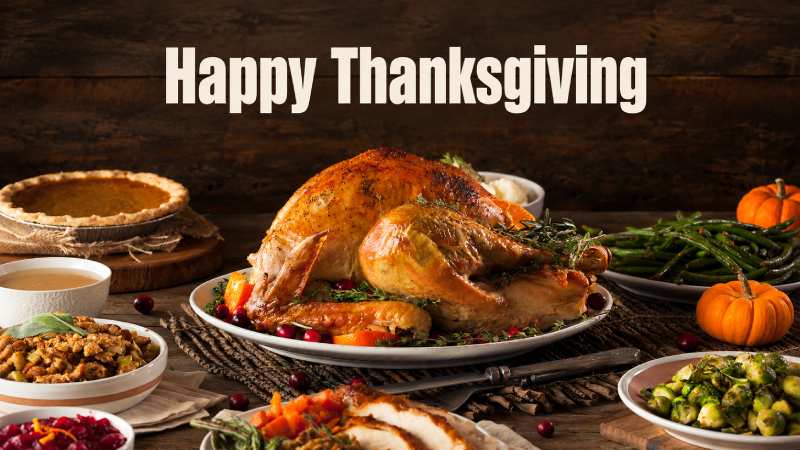
There are holidays we celebrate because the calendar tells us to, and there are holidays that gradually become part of the way a country sees itself. Thanksgiving belongs to the second group. Every November, millions of Americans travel home, prepare an enormous meal, watch football, talk over one another at the dinner table, and somehow turn an ordinary Thursday into one of the most emotionally loaded days of the year.
From the outside, Thanksgiving can look like one very large dinner. But I think reducing it to turkey, pumpkin pie, and family photos misses the more interesting part of the holiday. Behind all that food is a long history involving Indigenous peoples, European settlers, harvest customs, religion, war, politics, family, memory, and the very human need to stop for a moment and recognize what still matters.
That is probably the part I find most interesting. Traditions often survive longer than the meanings that created them. People remember what to cook, where to go, and what to watch on television, but sometimes forget why the ritual existed in the first place. Thanksgiving is no exception.
What is Thanksgiving and When is it celebrated?
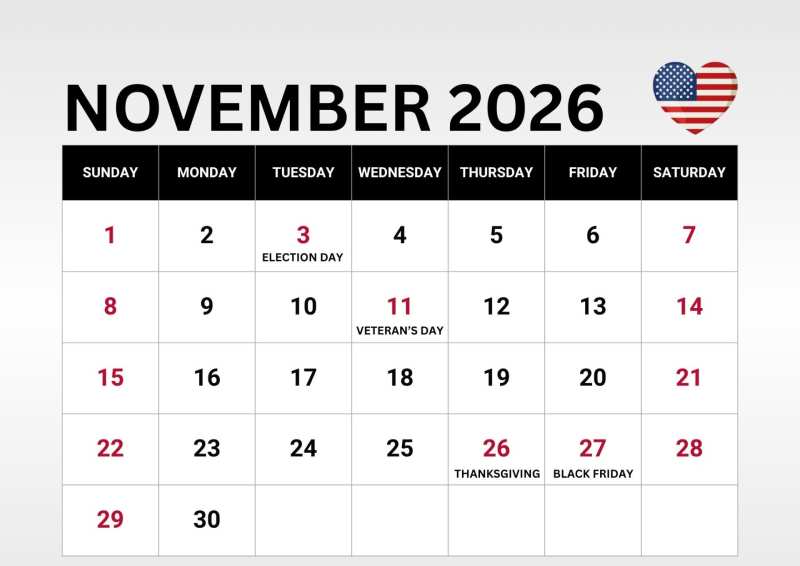
Thanksgiving is a major American holiday centered on gratitude, family, food, and togetherness. In the United States, it is celebrated every year on the fourth Thursday of November. In 2026, Thanksgiving falls on Thursday, November 26.
Thanksgiving is a federal holiday in the United States and one of the country’s most important annual family celebrations. Although its historical roots involve harvest traditions, religious observances, colonial history, and national politics, the modern holiday is much easier to recognize. People gather with family or friends, share a large meal, express gratitude, watch parades or football, volunteer in their communities, and begin turning their attention toward the Christmas season.
Unlike Christmas, Thanksgiving is not built around exchanging presents. There is no pressure to find the perfect gift for every relative, and the center of the day is not a decorated tree but a table. I rather like that about the holiday because, in a culture where almost every celebration can eventually become commercialized, Thanksgiving still preserves the idea that simply showing up may be enough.
Of course, modern Thanksgiving is not untouched by consumer culture. Black Friday follows immediately after it, and advertising often begins long before the turkey reaches the table. Still, the main ritual remains surprisingly simple. People come home, sit down, eat together, and, at least in theory, take a moment to appreciate what they have.
Thanksgiving does not fall on the same calendar date every year. It is always observed on the fourth Thursday of November, which means the date can fall between November 22 and November 28. In 2026, Thanksgiving will be celebrated on November 26.
For many Americans, the holiday also creates a long weekend. Schools close, offices may operate on reduced schedules, and millions of people travel across the country to spend time with relatives. Airports and highways become crowded every year, people complain about the journey every year, and yet they still go home. I think that says more about the meaning of Thanksgiving than any advertisement ever could.
The history behind thanksgiving
The modern Thanksgiving holiday did not simply begin with one peaceful dinner between Pilgrims and Native Americans in 1621. Harvest celebrations and traditions of giving thanks existed long before that event. The Plymouth gathering became an important part of the American Thanksgiving story later, while the national holiday itself developed over centuries.
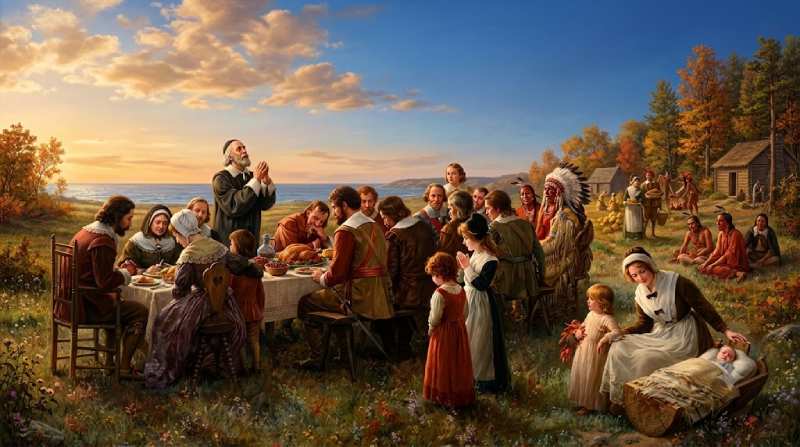
Ask an American child to draw the “First Thanksgiving,” and you can probably predict what will appear on the page: Pilgrims, Native Americans, a giant turkey, a long table, and perhaps a few pumpkins for good measure.
It is a powerful image. It is also an oversimplification.
The famous 1621 gathering
In the fall of 1621, English colonists at Plymouth and members of the Wampanoag participated in a harvest gathering that lasted several days. The event is real, but the neat little story Americans later built around it leaves out a great deal.
Native peoples had practiced traditions of gratitude and seasonal harvest celebrations for thousands of years before European colonization. The Wampanoag did not suddenly discover the concept of “Thanksgiving” when English settlers arrived.
Their relationship with the Plymouth colonists was also more politically complicated than the childhood version suggests. Cooperation existed, but so did diplomacy, strategic interests, cultural differences, disease, colonial expansion, and eventually devastating conflict.
So, was there a shared meal in 1621? Yes. Was it exactly the cozy multicultural potluck often depicted in school plays? Not quite. History rarely fits that neatly on a greeting card.
Thanksgiving did not instantly become an annual American holiday
Another common misconception is that Americans celebrated Thanksgiving every November from 1621 onward.
They did not.
Different colonies and communities observed days of thanksgiving at different times and for different reasons. Some were connected to harvests, while others marked military victories, survival, rain after drought, or religious gratitude.
In 1789, President George Washington proclaimed November 26 a national day of thanksgiving and prayer. Yet Thanksgiving still had not become the permanent annual holiday Americans know today. That transformation took decades and one remarkably persistent woman.
Sarah Josepha Hale helped turn Thanksgiving into a national tradition
If the name Sarah Josepha Hale does not immediately ring a bell, it probably should.
The influential magazine editor spent decades campaigning for a nationally recognized Thanksgiving holiday. She promoted Thanksgiving through editorials, recipes, stories, and letters to political leaders.
Basically, she kept knocking on America’s door until somebody answered.
In 1863, during the Civil War, President Abraham Lincoln proclaimed a national Thanksgiving observance in November. The timing is striking: the country was tearing itself apart, yet the holiday was framed around gratitude, unity, and reflection.
That gives Thanksgiving a deeper meaning than turkey and pie. It became a national ritual not during an easy chapter of American history, but during one of its darkest.
Later, after a controversial attempt by President Franklin D. Roosevelt to shift Thanksgiving earlier in the month, Congress established its modern calendar position. Since 1941, Thanksgiving has officially been observed on the fourth Thursday of November.
And that is how centuries of harvest customs, religious observances, political decisions, family practices, and national storytelling eventually became the Thanksgiving Americans recognize today.
What Thanksgiving really means
Modern Thanksgiving is primarily associated with gratitude, family, togetherness, generosity, and reflection. Its meaning varies from household to household, while Native American perspectives also encourage Americans to examine the more difficult history surrounding colonization.
There is something unusual about Thanksgiving.
America is a country that moves fast. Work harder. Build more. Buy more. Go somewhere. Do something. Keep up.
Then Thanksgiving arrives and, theoretically at least, asks everyone to stop.
Not forever. Just long enough to notice what is already there.
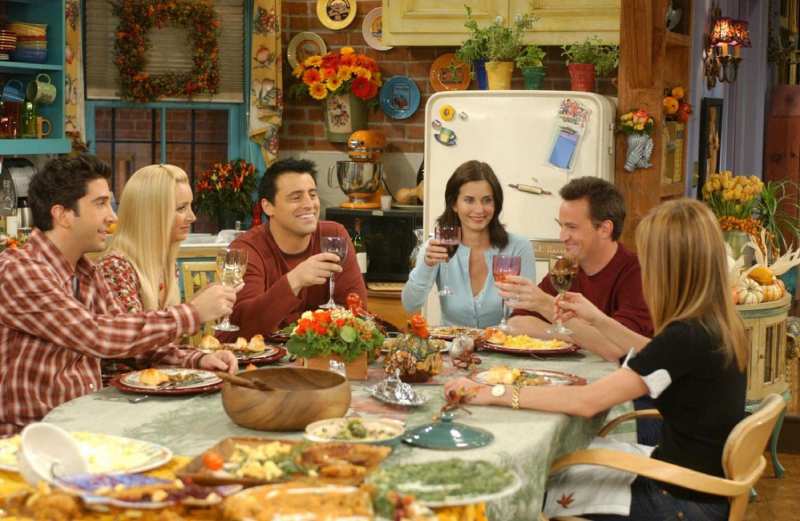
For some people, gratitude is religious. For others, Thanksgiving is entirely secular. Some celebrate with relatives, while others organize Friendsgiving, gathering with friends instead of or in addition to family.
The definition of “family” around the Thanksgiving table has become increasingly flexible.
And that may be one of the holiday’s strengths.
Thanksgiving does not require a perfect family portrait. Sometimes gratitude means sitting beside your parents and grandparents. Sometimes it means opening your apartment to friends who cannot travel home. Sometimes it means volunteering, delivering meals, calling someone who is alone, or simply admitting that the year was rough but there were still a few good things worth holding onto.
As Americans might say, when the going gets tough, the tough get going. But Thanksgiving adds another thought: once in a while, the tough should probably sit down, eat some pie, and appreciate how far they have come.
There is also another side of the holiday that deserves space.
For many Native Americans, Thanksgiving can carry painful associations with colonization and the historical treatment of Indigenous peoples. Some observe the day differently, and since 1970, Native people and supporters have gathered in Plymouth, Massachusetts, for a National Day of Mourning.
Gratitude and historical honesty do not have to cancel each other out.
A mature understanding of Thanksgiving can make room for both.
Thanksgiving traditions: What Americans actually do
Popular Thanksgiving traditions include gathering with family and friends, sharing a large meal, expressing gratitude, watching parades and football, volunteering, traveling home, and increasingly celebrating Friendsgiving. The dinner may be the headline act, but Thanksgiving has accumulated plenty of supporting traditions.
Getting together with family
For millions of Americans, Thanksgiving means traveling home. Adult children return to their parents’ houses. College students come back for the long weekend. Grandparents suddenly have kitchens full of people again. The logistics can be exhausting, but people do it anyway. Because sometimes “home for the holidays” is less about the house and more about who is waiting inside it.
Saying what you are thankful for
Some families have everyone share one thing they appreciate before dinner. Yes, it can become awkward. Yes, there is always a chance somebody will deliver a five-minute speech while the mashed potatoes slowly go cold. Still, the ritual captures the central purpose of the holiday: deliberately recognizing the good things we normally take for granted.
Watching the Thanksgiving parade
Parades have become another recognizable feature of Thanksgiving morning, with enormous balloons, marching bands, elaborate floats, performers, and crowds lining city streets. For many households, the parade plays on television while everyone cooks.
Nobody may be watching every second, but turn it off and suddenly somebody will ask, “Hey, who changed the channel?”. Tradition is funny like that.
Watching football
Then comes football. Football and Thanksgiving have been connected for generations, from school and college rivalry games to professional football broadcasts. For some families, the television stays on all afternoon. For others, the tradition involves heading outside for an informal family game before dinner. Either way, Thanksgiving without football would feel strange to a large slice of America.
Friendsgiving
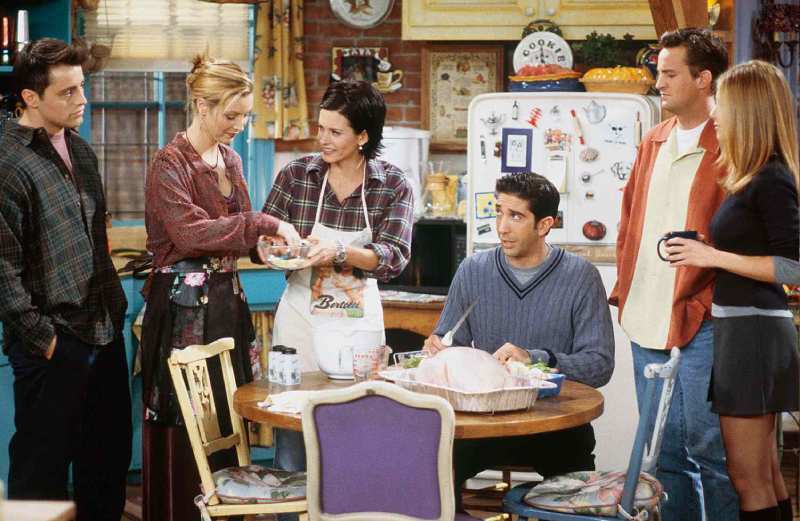
Not everyone can or wants to spend Thanksgiving with relatives. Enter Friendsgiving. The idea is exactly what it sounds like: Thanksgiving celebrated with friends. It may happen on Thanksgiving Day itself or sometime before or after the holiday.
There are fewer rigid rules, everyone usually brings something, and somebody inevitably shows up with wine but forgets the side dish they promised. Close enough.
What do Americans eat on Thanksgiving?
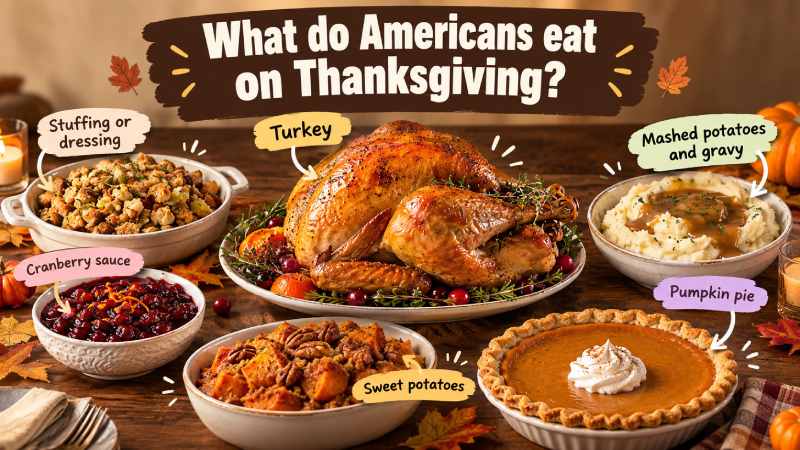
A traditional American Thanksgiving dinner commonly includes roast turkey, stuffing or dressing, mashed potatoes, gravy, cranberry sauce, sweet potatoes, vegetables, dinner rolls, and pumpkin pie. However, menus vary considerably by region, heritage, and family tradition.
If Thanksgiving has a universal language in America, it is probably food.
Turkey
Turkey is the undisputed celebrity of the modern Thanksgiving table. Americans roast it, smoke it, deep-fry it, brine it, stuff it, and debate endlessly about how to stop it from becoming dry.
Interestingly, historians cannot say with certainty that turkey was served at the 1621 Plymouth gathering. Historical accounts mention wild fowl, but the turkey’s starring role developed much later. Today, however, the bird has Thanksgiving practically written into its résumé.
Stuffing or dressing
Bread, herbs, vegetables, butter, stock, and family arguments. That is stuffing in a nutshell.
Recipes vary enormously, and even the name changes depending on where you are. Some Americans say stuffing, while others particularly in parts of the South prefer dressing. Families add sausage, cornbread, oysters, celery, nuts, fruit, or recipes inherited from grandparents. Tell someone their grandmother’s stuffing recipe is wrong at your own risk.
Mashed potatoes and gravy
Thanksgiving is not the day for counting carbs. Fluffy mashed potatoes covered in rich gravy are about as classic as American comfort food gets. Gravy also performs an important public service by rescuing a turkey that stayed in the oven fifteen minutes too long. No judgment. It happens to the best of us.
Cranberry sauce
Few Thanksgiving foods divide a table quite like cranberry sauce. Some families make it from fresh cranberries with orange zest and spices. Others proudly open a can and serve the perfectly cylindrical jelly exactly as it comes out.
Fancy? No. Nostalgic? Absolutely.
Sweet potatoes
Depending on the family, sweet potatoes may appear mashed, roasted, baked into a casserole, or topped with marshmallows. To visitors from outside the United States, marshmallows on vegetables may raise a few eyebrows. Americans have heard your objections. The casserole is staying.
Pumpkin pie
Finally, dessert. Pumpkin pie flavored with cinnamon, ginger, nutmeg, and other warm spices has become one of the defining tastes of the American fall.
Apple pie and pecan pie frequently join the party, because apparently one pie after an enormous dinner would be far too reasonable. Thanksgiving is not really a “less is more” kind of holiday.
Interesting Thanksgiving facts
Many familiar Thanksgiving “facts” are actually later traditions or popular myths. Turkey was not confirmed on the 1621 menu, Thanksgiving became a national observance centuries later, football developed into a holiday tradition long afterward, and the date itself once caused a national political controversy.
Here are a few facts worth bringing to the dinner table preferably before your uncle starts telling the same story he told last year.
- The 1621 meal was not necessarily the first Thanksgiving in North America. Various Native peoples had long-established traditions of giving thanks, while Europeans had also held earlier thanksgiving observances in North America.
- Turkey is not confirmed on the 1621 menu. Historical records mention wild fowl, but there is no definitive evidence that the guests were carving up the Thanksgiving turkey we imagine today.
- Pumpkin pie was not sitting on the table either. The classic modern Thanksgiving menu developed over time rather than arriving fully formed in 1621.
- Thanksgiving became nationally established during the Civil War era. Lincoln’s 1863 proclamation helped transform Thanksgiving into an annual national observance during an extraordinarily divided period in American history.
- A magazine editor played a major role in making it happen. Sarah Josepha Hale campaigned for decades for a national Thanksgiving holiday.
- Americans once disagreed over when Thanksgiving should happen. Franklin D. Roosevelt moved the observance earlier in 1939 partly to lengthen the Christmas shopping season, creating considerable confusion and controversy.
- Congress eventually settled the matter. Federal legislation established Thanksgiving on the fourth Thursday of November.
- Football has been connected with Thanksgiving for well over a century. The association grew alongside the development of American football itself.
- Thanksgiving food is not identical across America. Regional and cultural traditions may add macaroni and cheese, cornbread dressing, collard greens, tamales, rice dishes, seafood, or recipes reflecting a family’s immigrant heritage.
- Thanksgiving is increasingly celebrated beyond the traditional nuclear family. Friendsgiving and other community-centered gatherings reflect how Americans continue to reshape the holiday around modern life.
That last point may be the most interesting one. Traditions survive not because nobody changes them, but because each generation finds a reason to keep them.
Conclusion
If we remove the parade, the football, the turkey, the stuffing, the cranberry sauce, the pumpkin pie, the Black Friday advertising, the seasonal decorations, and every other thing Americans have gradually attached to Thanksgiving, what remains is surprisingly simple.
There is a table, some people sitting around it, and the idea that before racing toward whatever comes next, we might stop long enough to acknowledge what has already been given to us.
That idea feels almost radical now. We live in a culture that constantly asks what is next. Thanksgiving asks what is already here. Of course, the history of the holiday deserves to be told honestly. The comfortable childhood version of Pilgrims and Native Americans happily inventing Thanksgiving together is not enough. The experiences of the Wampanoag and other Indigenous peoples belong in the story too.
Gratitude should not require historical amnesia. At the same time, historical honesty does not make gratitude meaningless. If anything, I think it makes the holiday more mature. Thanksgiving does not need a perfect origin story, a perfect family, or a perfect year to remain worth celebrating.
Maybe people simply need to remember why they came to the table in the first place. Because Thanksgiving is not really about how much food is on the table. It is about noticing who is sitting around it, appreciating the people who are still there, and sometimes remembering the ones who are not.