

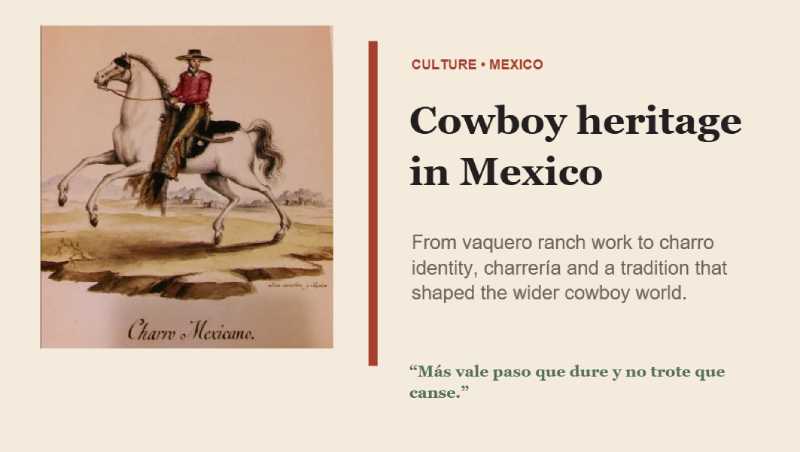
Long before Hollywood gave the world its familiar image of a cowboy riding alone across the American West, Mexican horsemen were already managing cattle, throwing ropes, building saddles and developing a riding culture that would eventually travel far beyond Mexico’s borders. The cowboy heritage in Mexico is therefore not simply a Mexican version of the American cowboy story. In many ways, it is one of the older roots from which the wider cowboy tradition of North America grew. What began as practical ranch work gradually became charrería, a carefully preserved equestrian tradition filled with skill, clothing, craftsmanship, music, family pride and enough ceremony to make it much more than a sport.
Cowboy heritage in Mexico — Charrería & vaquero culture.pptx của Minh Di Trần
The origins and meaning of cowboy heritage in Mexico
Quick answer: Cowboy heritage in Mexico is a ranching and equestrian tradition that developed from cattle raising communities in central and northern Mexico in the sixteenth century, when mounted workers learned to manage livestock across large estates using horses, saddles and ropes. Over time, those working skills became the basis of charrería, now one of Mexico’s most recognizable cultural traditions.
From ranch work to a national tradition
The story of cowboy heritage in Mexico begins with cattle.
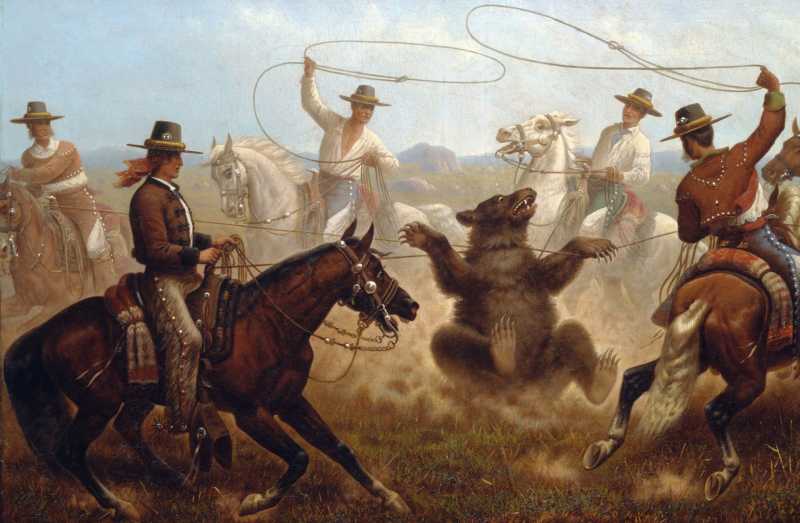
Spanish colonization introduced large scale cattle ranching and European horse culture to what is now Mexico during the sixteenth century. As ranches expanded through central and northern regions, workers needed practical methods for identifying, moving and controlling livestock belonging to different estates. According to Mexico’s National Institute of Anthropology and History, these ranching conditions encouraged vaqueros to cooperate and develop specialized techniques using horses, saddles and the reata, or rope.
The Spanish word vaquero comes from vaca, meaning cow, and quite literally refers to someone who works cattle. Smithsonian material defines vaquero as the Spanish equivalent of cowboy and emphasizes the Mexican roots of many traditions later associated with the American West.
Yet the Mexican tradition did not remain purely occupational. Ranching techniques slowly became formal displays of horsemanship. Families passed skills from one generation to the next, while riders developed increasingly recognizable clothing, tack, competitions and codes of conduct. Eventually, these practices became what Mexicans know as charrería.
The UNESCO inscription for charrería describes it as a traditional practice that originated among livestock herding communities and later developed into organized associations, schools and competitions. In 2016, UNESCO placed charrería on the Representative List of the Intangible Cultural Heritage of Humanity.
That recognition matters because Mexican cowboy culture is not merely a performance recreated for tourists. It remains a living tradition practiced by families, clubs, riders, artisans and local communities.
What is the difference between a vaquero and a charro?
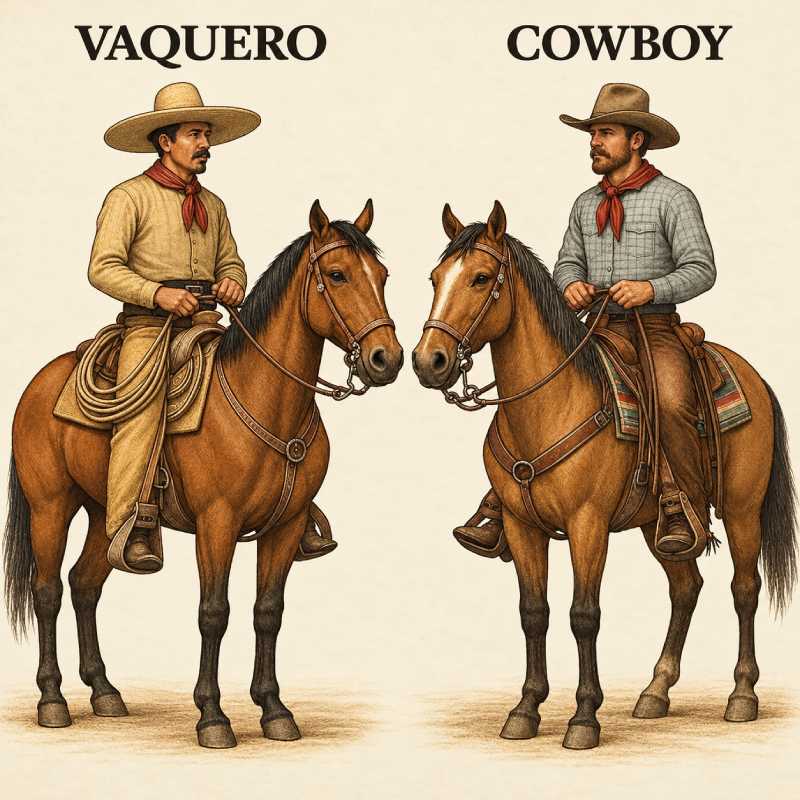
The terms are related, but they are not exactly interchangeable.
A vaquero was historically a working cattle hand, someone whose daily responsibilities involved horses, livestock, fences and ranch life. A charro, meanwhile, became associated with a more formal Mexican equestrian tradition and eventually with charrería itself.
The modern charro is recognizable through refined riding skills, traditional dress and participation in charreadas, organized events in which riders demonstrate techniques derived from historic ranch work.
This distinction is important because popular culture sometimes treats the charro simply as “Mexico’s cowboy in a fancy suit.” That misses the deeper story. A charro represents an equestrian tradition that turned agricultural labor into cultural heritage.
Why does this heritage matter in Mexico?
Few images have become as closely tied to Mexican national identity as the charro. Mexico’s own agricultural authorities note that the charro became especially prominent as a symbol of Mexican identity during the twentieth century.
Cinema, music and public celebrations strengthened that association. The image of a rider in a wide sombrero, embroidered jacket and fitted trousers entered films, posters, mariachi culture and national celebrations until the charro became recognizable even to people who had never attended a charreada.
Yet behind the romantic image remains something much more practical: generations of people who knew horses, livestock and land.
There is a Mexican saying, “Más vale paso que dure y no trote que canse,” which roughly means that a steady pace that lasts is better than a fast trot that exhausts you. It is not exclusively a cowboy proverb, but it feels remarkably appropriate here. Charrería survived because it was carried steadily from ranches into families, clubs and cities rather than preserved as a frozen relic.
When is National Charro Day?
Mexico celebrates Día Nacional del Charro, or National Charro Day, every September 14. Government sources identify September 14 as the annual day honoring charros and charrería, and communities may mark it with parades, riders in traditional dress and cultural events.
The date falls as follows over the next five years:
| Year | National Charro Day |
| 2027 | Tuesday, September 14, 2027 |
| 2028 | Thursday, September 14, 2028 |
| 2029 | Friday, September 14, 2029 |
| 2030 | Saturday, September 14, 2030 |
| 2031 | Sunday, September 14, 2031 |
National Charro Day should not be confused with one single nationwide “cowboy festival.” Local celebrations vary by state and municipality, while charrería events take place throughout the year.
What happens in Mexican cowboy culture?
Quick answer: Modern charrería combines horseback riding, cattle handling, roping, traditional dress, music, craftsmanship and family participation. A typical charreada turns skills that once belonged to ranch work into a formal cultural and sporting event.
The charreada and traditional riding skills
The most visible expression of cowboy heritage in Mexico today is the charreada, an organized charrería competition generally held in a purpose built arena known as a lienzo charro.
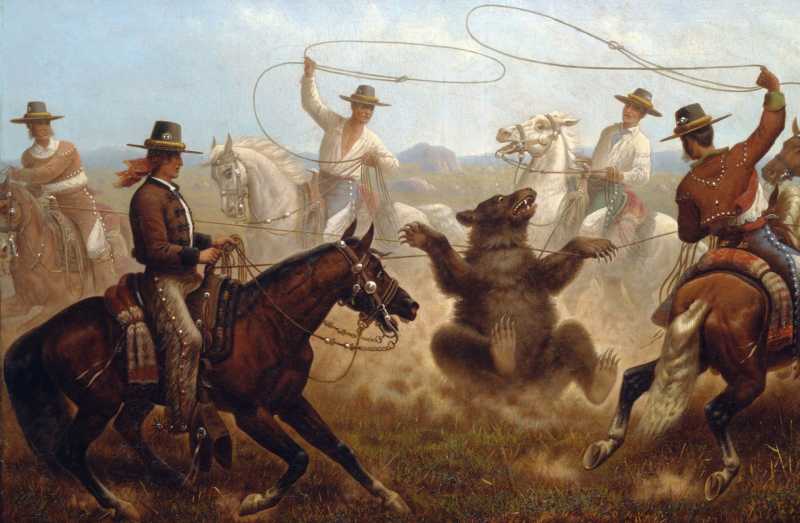
The exercises are not random rodeo tricks. Many grew directly from ranching tasks. Riders demonstrate control of horses, rope cattle, handle bulls and perform other highly technical maneuvers. Mexico’s cultural authorities describe charrería as a Mexican equestrian school rooted in livestock management and the use of the saddle and rope.
Traditional events may include the cala de caballo, which demonstrates a horse’s training and responsiveness; piales en el lienzo, involving roping; coleadero, a cattle handling event; bull and mare riding; team roping exercises; and manganas, in which riders demonstrate precision with the rope.
To an unfamiliar visitor, some of these events may look similar to rodeo. Historically, however, it is more accurate to understand charrería as a related equestrian tradition with its own rules, language and cultural development.
The cowboy heritage in Mexico is therefore best experienced not as a costume show but as horsemanship under pressure. The rider’s posture, control of the horse, rope technique and timing all reveal skills that took years to develop.
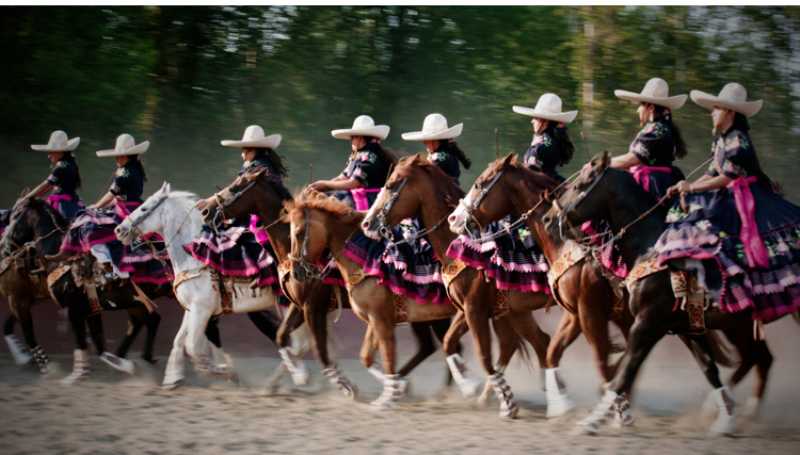
Escaramuza and the role of women
Women are also an important part of modern charrería.
The best known female event is the escaramuza charra, typically performed by teams of women riding horses in coordinated formations. Mexico’s Secretariat of Culture notes the importance of escaramuzas, who perform equestrian routines while wearing distinctive traditional dresses.
Their performances are fast, precise and visually dramatic. Riders cross paths, turn in formation and control their horses while riding sidesaddle, making the event one of the most recognizable parts of a modern charreada.
This part of cowboy heritage in Mexico also helps correct the idea that ranch culture belongs exclusively to men. Women have become highly visible practitioners and transmitters of charrería, strengthening a tradition that UNESCO itself describes as something passed through communities and generations.
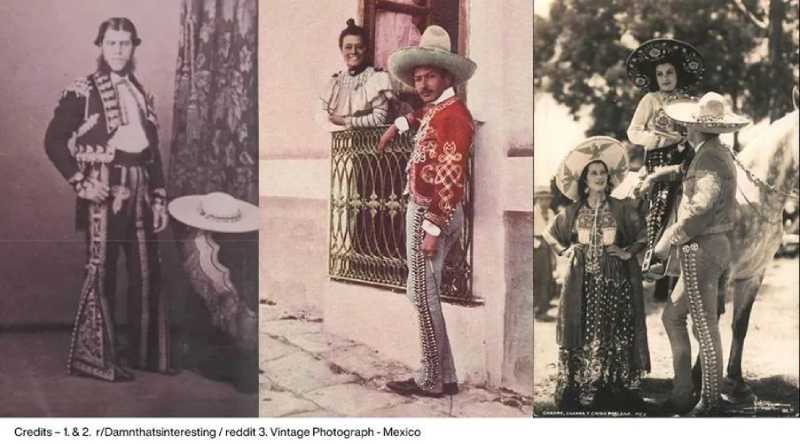
What do Mexican charros wear?
The charro suit is perhaps the most immediately recognizable element of cowboy heritage in Mexico.
Men traditionally wear fitted trousers, a short jacket, boots and a wide brimmed sombrero. Formal suits may include elaborate embroidery, silver buttons and carefully coordinated details. The hat is not merely decorative. Its broad shape reflects an equestrian environment in which protection from sun and weather mattered.
Women participating in escaramuza wear long, colorful dresses inspired by nineteenth century styles, often with full skirts designed to create dramatic movement while riding.
UNESCO also emphasizes that local artisans continue to produce clothing, saddles, spurs and other equipment used in charrería, meaning the tradition supports crafts as well as riding.
This is one of the details I find most interesting about the cowboy heritage in Mexico. The culture does not stop with the rider. Saddlers, embroiderers, hat makers, leatherworkers and other craftspeople are part of the same cultural ecosystem.
A horseman may be the person everyone watches, but a great deal of invisible work went into what he is wearing and riding.
Is there traditional food connected with charro culture?
There is no single official “charro menu,” because charrería developed across several Mexican ranching regions and food traditions vary enormously from state to state. Still, charreadas and regional festivals often take place in the same cultural world as ranch style Mexican cooking.
Visitors may encounter grilled meats, tacos, barbacoa, regional stews, beans, tortillas and dishes associated with the local state rather than one standardized national menu. Jalisco, Hidalgo and central Mexican ranching regions each bring their own culinary identities to the table.
Food matters at these gatherings for the same reason it matters at so many traditional festivals. Heritage becomes easier to keep alive when people can eat it, hear it and share it instead of merely reading about it.
A charreada without conversation, music and food would still be a sporting competition. With them, it becomes a social occasion.
Music, family and atmosphere
Mariachi and charrería are separate traditions, and both have their own histories, but modern Mexican cultural celebrations frequently place them beside one another. The visual connection is particularly strong because the charro style of dress became closely associated with mariachi musicians during the twentieth century.
This overlap has done a great deal to create the global image of Mexico: embroidered suits, sombreros, horses, trumpets and violins all appearing within the same cultural frame.
Yet reducing cowboy heritage in Mexico to this postcard image would be a mistake. At its most authentic, charrería is also about families spending weekends together, children learning to ride, older practitioners teaching younger ones and communities preserving knowledge that once belonged to daily agricultural life.
As Mexicans sometimes say when it is time to stop talking and get moving, “¡A darle que es mole de olla!” The phrase roughly means, “Let’s get to it,” and carries exactly the kind of practical energy that fits a culture built around work before spectacle.
How Mexican cowboy culture influenced other countries
Quick answer: Mexico’s vaquero tradition strongly influenced the cowboy culture of the United States, particularly across the American Southwest. Elsewhere in the Americas, similar cattle riding cultures developed their own identities, including the gaucho in Argentina and Uruguay, the llanero in Venezuela and Colombia, and the huaso in Chile.
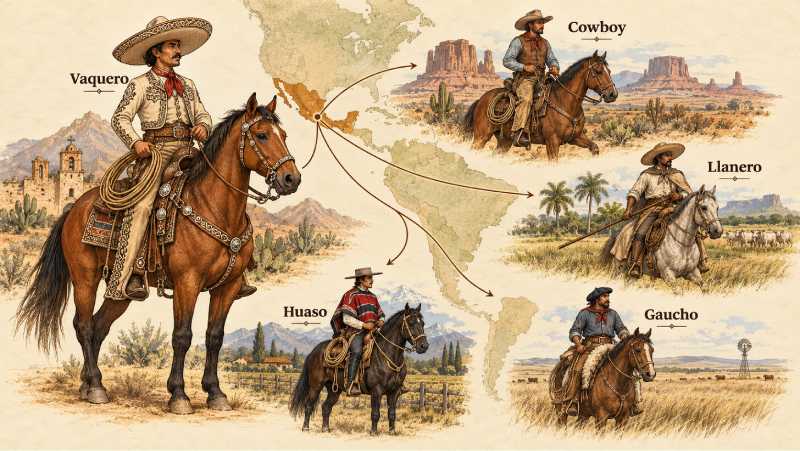
The American cowboy and the Mexican vaquero
The strongest international connection is with the United States.
Popular culture often treats the cowboy as an essentially American invention, complete with cattle drives, lassos, boots and wide hats. The historical picture is much more interconnected.
Smithsonian research notes that major symbols of the American West, including cowboys, rodeos and ranches, developed through centuries of exchange among Spanish, Mexican and Indigenous communities in lands stretching from California to Texas. Mexican vaqueros contributed riding techniques, livestock knowledge and terminology that later became part of the American cowboy tradition.
Even the word rodeo comes from Spanish, while vaquero itself eventually helped produce the English word buckaroo through regional pronunciation.
This is why cowboy heritage in Mexico should not be treated as a side story to the American West. It belongs near the beginning of the story.
The Smithsonian American Art Museum makes the connection explicit through Luis Jiménez’s monumental sculpture Vaquero, created to emphasize the Mexican and Mexican American roots of the classic cowboy image.
Gauchos, llaneros, huasos and other horse cultures
Mexico is far from the only Latin American country with a strong horseback cattle culture.
On the pampas of Argentina and Uruguay, the gaucho became the legendary horseman of the open grasslands. In Venezuela and Colombia, cattle workers of the Llanos are known as llaneros, riders shaped by vast tropical plains and ranching life. Chile has the huaso, whose clothing, horsemanship and rural traditions became important symbols of national culture.
These traditions are cousins rather than copies.
They emerged within different landscapes, colonial histories and local societies. A Mexican charro is not simply a gaucho with a sombrero, just as an Argentine gaucho is not a South American version of an American cowboy. Each tradition developed its own clothing, riding techniques, music, vocabulary and national meaning.
What they share is a larger history of cattle ranching, horses and rural life throughout the Americas.
From working horseman to cultural icon
The journey of cowboy heritage in Mexico mirrors something seen in many countries. A job becomes a way of life, a way of life becomes a tradition, and eventually the tradition becomes part of national identity.
The American cowboy moved from cattle drives into Hollywood. The Argentine gaucho moved from the pampas into literature and folklore. The Mexican charro moved from ranch work into charrería, cinema and national imagery.
In every case, mythology eventually grew around the worker.
That can be both useful and dangerous. Myth keeps traditions visible, but it can also polish away the hard work that created them. The real vaquero was not posing for a film poster. He was working livestock before dawn.
That distinction is worth remembering.
The hat may become famous.
The labor underneath it usually does not.
Conclusion
The cowboy heritage in Mexico is much older and richer than the familiar image of a man in a sombrero riding dramatically across a dusty landscape. It began in the practical ranching world of the sixteenth century, developed through generations of vaqueros and charros, and eventually became charrería, a living tradition recognized by UNESCO and celebrated every September 14 on National Charro Day. Its influence also travelled north and helped shape the cowboy culture later made famous by the United States, while related horse cultures developed their own identities elsewhere in Latin America. Perhaps that is the most interesting part of the story: behind the embroidery, music and spectacle is an old culture of work, horses, family knowledge and skills passed hand to hand. Cowboys became legends later. First, they had cattle to move.